 KETA PILATES
Buying guide
What Is a Pilates Chair and Who Needs One
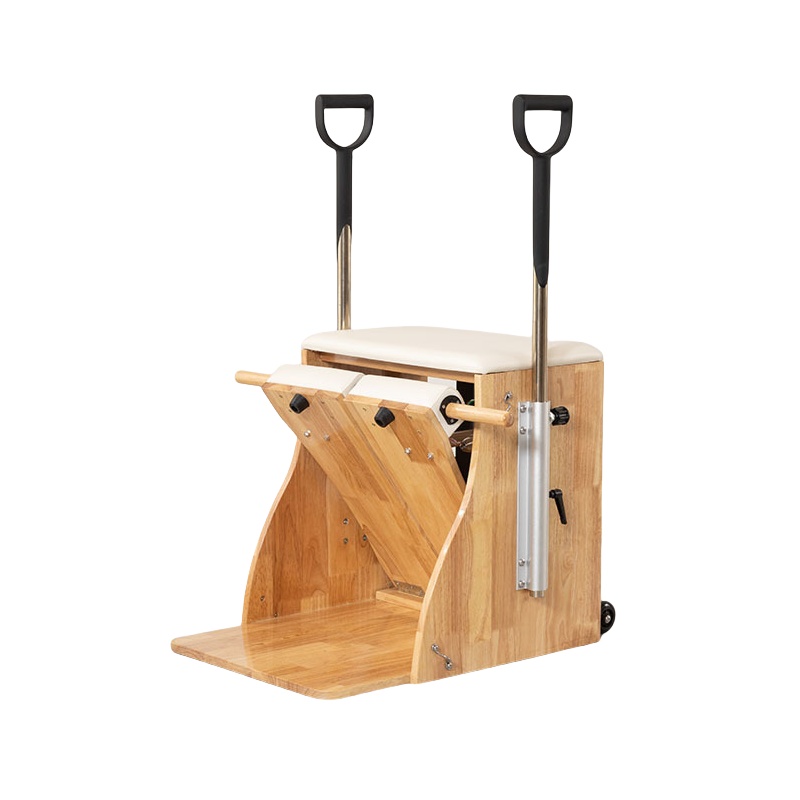
A Pilates chair looks like the smallest machine in the studio and the easiest one to ignore. It is a seat with a spring-loaded pedal, sometimes a split pedal, and a frame you can stand on. Get the order wrong and it becomes the machine nobody uses. Get it right and it becomes the station that fills the gaps a reformer cannot — and the one clients ask for by name.
1. What a Pilates chair actually is
A chair is a compact, square frame with a padded seat and a spring-loaded pedal at the front. You sit on it, stand on it, or lean on it, and press the pedal with one foot or two. The springs give resistance; the small base gives instability. That combination is the whole point: it trains balance and control in a way a long, stable reformer cannot.
Most commercial chairs let you adjust spring tension in a few steps, and many offer a split pedal so each leg works independently. That is the version a studio should buy — a fixed single pedal limits what you can teach.
2. What a chair does that a reformer does not
The reformer is a lying-down machine. The chair is a sitting-and-standing machine, and that changes the exercises:
- Seated work: pressing the pedal from a seated position loads the core, hips and legs with the trunk upright.
- Standing work: standing on the frame and pressing the pedal trains balance and single-leg strength — close to how clients actually move.
- Asymmetry: with a split pedal, one side can push while the other controls, which is hard to replicate on a reformer.
- Short, sharp sets: chair exercises are quick and intense, which makes it easy to slot into a class or a private.
In short, the chair adds balance, standing strength and single-leg control — the three things a reformer-based programme tends to under-train.
3. Who actually needs one
Not every studio does. The chair earns its place when:
- you teach mixed-level classes and want a station that challenges strong clients in a small footprint;
- you run privates and rehab and need standing and balance work a reformer cannot give;
- your floor space is tight — a chair fits where a second reformer would not;
- you want a machine that clients can buy for home without needing a spare room.
If every session is a reformer flow and no client asks for balance work, a chair will sit idle. Buy it when the demand is there, not because a catalogue bundles it.
4. Space and cost
This is the chair's real advantage. It occupies a fraction of a reformer's footprint, needs no ceiling clearance and can tuck against a wall between sessions. In a small studio it often replaces the "one more reformer" that does not fit.
On cost, a chair sits well below a reformer, which makes it the cheapest way to add a genuinely different station. A pair of chairs can cover a small group class at a lower spend than a single reformer.
5. Chair versus reformer — the buying order
For most studios the order is: reformers first, because they carry the classes; then a chair or two to add variety and balance work; then, if privates grow, a tower or a Cadillac. The chair is the low-risk second purchase — cheap, small, and different enough to justify itself. Buying two chairs before you have filled your reformers is usually the wrong way round.
6. What to specify when you order
The spec lines that matter on a chair are shorter than on a reformer, but they are not zero:
- Adjustable, split pedal — so each leg can work independently;
- spring set — replaceable springs with a couple of tension steps, not one fixed resistance;
- rated load and frame — a commercial frame that survives standing clients, in aluminium for humid or clinical rooms or oak / maple / beech for a warmer studio;
- upholstery density — the seat takes full body weight, so thin foam flattens fast;
- certifications — CE for the EU, ISO 9001 for the production system, third-party SGS / TÜV where applicable;
- packing, spare fittings and an installation video for the exact model.
Ask for the seat height and pedal travel too — those decide whether taller clients can use it comfortably.
The bottom line
A Pilates chair is the small, cheap, high-variety machine that fills the balance and standing-strength gap a reformer leaves. Buy one when clients ask for balance work, when your floor space is tight, or when you want a second station without a second reformer. Buy two if you run small group classes. Skip it only if every session is a straight reformer flow.
We build a commercial Pilates chair (PC001) with an adjustable split pedal, replaceable multi-step springs, a rated commercial frame in aluminium or oak / maple / beech, high-density upholstery, CE / ISO 9001 and SGS-tested where applicable, AQL pre-shipment inspection, CTI-audited production and a live video factory tour. MOQ is 5 pieces and you can mix chairs, reformers, towers and Cadillacs in one container. Spare fittings and an installation video ship with the order.
Choosing reformers for a studio or a first container?
Send us your room dimensions, expected weekly usage and destination port. We will tell you which frame and specification actually suits you — and if a cheaper option is the right one, we will say so.
Request a quote