 KETA PILATES
Buying guide
Pilates Barrel and Spine Corrector: What They're For
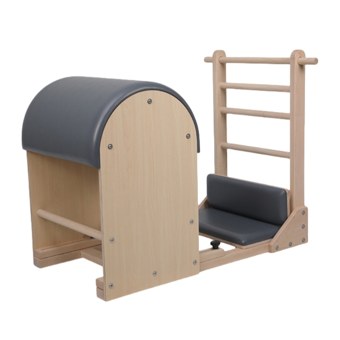
Two of the most puzzling machines in a Pilates studio are also the cheapest: the barrel and the spine corrector. They have no springs, no carriage and no moving parts, so buyers often assume they are optional extras and skip them. That is a mistake — for a specific kind of client and a specific kind of body, they do work a reformer simply cannot. This guide explains what each one is, what they do, how they differ, and which to buy first.
1. What a Pilates barrel is
A barrel — often called a ladder barrel — is a padded arc mounted on a base, with a set of wooden or metal rungs (the ladder) rising behind it. You lie over the arc, sit on it, or stand and hold the ladder. The curve supports the spine in extension or side-bending; the ladder gives you something to hold while you stretch, rotate or hang.
It is a passive tool. Nothing moves except you. That is deliberate: the arc holds your spine in a position your own muscles cannot hold alone, and holding that position is the exercise.
2. What a spine corrector is
A spine corrector is the smaller brother: a padded arc on a low base, usually without a ladder, sometimes with a handle slot or two. It sits on the floor or on a mat, and you lie over it lengthways or across it. It is the same principle — support the spine in a curve — but in a smaller, cheaper, more portable form.
Most studios that buy only one buy the spine corrector first, because it costs less, takes almost no floor space, and can be used on a mat in a group class.
3. What they actually do
Both machines earn their place on four jobs:
- Spinal extension. Lying back over the arc opens the front of the body and restores extension — the antidote to a day spent hunched forward.
- Shoulder and chest opening. The arc lets the shoulder blades move freely, which is hard to achieve lying flat.
- Lateral work. Lying across the arc and side-bending targets the muscles along the spine that reformer work rarely reaches.
- Supported stretch and release. Because the machine holds you, clients can relax into a stretch instead of bracing to hold a position.
That last point is why rehab and physiotherapy buyers value them: the arc lets a client receive a stretch passively, which is often the only way to progress someone in pain.
4. Who actually needs them
Buy a barrel or a spine corrector when:
- you work with clients with stiff or flexed spines — desk workers, drivers, older clients;
- you run rehab, physiotherapy or posture programmes;
- you teach teacher training and need the classical apparatus on the floor;
- you want a cheap station that adds a genuinely different sensation to a class.
If every class is a reformer flow and no client complains about a stiff back, these will gather dust. They are problem-solving machines, not general-purpose ones.
5. How they differ from a reformer
A reformer trains strength through resistance. These train position and mobility through support. The client is not working against springs — the arc is doing the work of holding a shape, and the body adapts to it. That is why they pair well with reformers rather than compete with them: one builds strength, the other restores range.
6. Barrel versus spine corrector — which to buy first
- Spine corrector first if budget or floor space is tight. It is cheaper, smaller, portable, and usable in a mat class.
- Barrel first if you teach privates or classical apparatus, or you want the ladder for standing stretch and rotation work.
- Both if you run teacher training or a full apparatus studio — they are frequently used together in the same session.
Most new studios start with two spine correctors and add one barrel later. That order keeps the spend low and gets a mat-class tool into use immediately.
7. What to specify when you order
There are fewer moving parts, but the spec still matters:
- Arc dimensions and radius — taller clients need a longer arc to lie over comfortably;
- upholstery density — the whole body presses on the arc, so thin foam flattens and the curve loses its shape;
- frame material — aluminium for humid or clinical rooms, oak / maple / beech for a warmer studio;
- non-slip base or feet — the machine must not slide when a client leans on it;
- certifications — CE for the EU, ISO 9001 for the production system, third-party SGS / TÜV where applicable;
- packing, spare fittings and an installation video for the exact model.
The bottom line
A barrel and a spine corrector are the cheap, low-risk machines that fix the one thing reformers do not: a stiff, flexed spine. Buy a spine corrector first if space or budget is tight, add a barrel when you run privates or teacher training, and skip them only if no client in your studio complains about their back.
We build both: a ladder barrel (BR001) and a spine corrector (SC001), in aluminium or oak / maple / beech with high-density upholstery, CE / ISO 9001 and SGS-tested where applicable, AQL pre-shipment inspection, CTI-audited production and a live video factory tour. MOQ is 5 pieces and you can mix barrels, spine correctors, chairs, reformers, towers and Cadillacs in one container. Spare fittings and an installation video ship with the order.
Choosing reformers for a studio or a first container?
Send us your room dimensions, expected weekly usage and destination port. We will tell you which frame and specification actually suits you — and if a cheaper option is the right one, we will say so.
Request a quote