 KETA PILATES
Buying guide
How to Choose a Reformer for Tall Clients
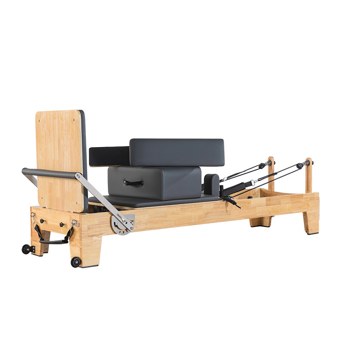
Most reformers are built around an average body, and most clients fit them. The problem shows up at the top end: a client over about 185 cm (6 ft 1 in) can run out of carriage, hit the footbar with their knees, or find the headrest too short to support them. Studios in the Netherlands, the Nordics, Germany and much of North America hit this often enough that it is worth specifying for before you order — not after the container lands.
1. Why height breaks a reformer
Four things have to line up for a tall body:
- Frame length — the client must be able to lie down with the head supported and the feet on the footbar without running off the end.
- Carriage travel — how far the carriage actually slides. This is usually the first thing tall clients run out of.
- Footbar position — where the bar sits relative to the shoulders when lying down.
- Headrest and shoulder rest adjustment — if these cannot move far enough, the neck is left unsupported.
A machine can look long and still fail on carriage travel, which is why overall length alone is not a spec to buy on.
2. Frame length — what the numbers look like
Commercial reformers are not all the same length, and the frame material matters. As a working guide across a typical commercial range:
- Aluminium frames: roughly 2,110–2,560 mm
- Oak frames: roughly 2,280–2,410 mm
- Maple frames: roughly 2,310–2,380 mm
- Beech frames: around 2,300 mm
The spread is wider than most buyers expect. If your clients run tall, ask for the longest frame in the material you want rather than the default, and confirm the measurement refers to the overall frame rather than just the bed.
3. Carriage travel — ask for this number
This is the spec most quotations leave out, and it is the one that decides whether a tall client can actually use the machine. Carriage travel is the distance the carriage moves from stop to stop. More travel means a longer stride and a longer reach for both legs and arms.
Ask the supplier for the travel figure in millimetres. If they cannot give it, that is a sign the machine was not engineered around a written specification, and your tallest clients will be the ones who notice.
4. Footbar, headrest and rope length
Three smaller adjustments do a lot of the work:
- a footbar with multiple positions, ideally both height and fore-aft, so long legs can set up properly;
- an adjustable headrest that genuinely extends, rather than a fixed padded block;
- longer ropes and straps — standard sets are frequently too short for tall clients to reach comfortably in long spine or arm work.
None of these is expensive on its own. Together they decide whether your tallest client can do the full repertoire or only part of it.
5. Spring set and load rating
Taller clients are usually heavier, and weight matters as much as height. Specify a five to six spring set so resistance can be scaled properly, and a load rating that covers daily commercial use by larger bodies. A machine that is long enough but rated lightly will wear quickly under a tall-client load.
6. What to ask your supplier before you order
Put these in writing before you pay:
- overall frame length in mm, and which measurement it refers to;
- carriage travel in mm;
- footbar adjustment range (how many positions, and in which directions);
- headrest adjustment range;
- rope and strap length;
- spring count and load rating;
- whether the longest frame is available in the material and finish you want.
A supplier who answers all seven quickly is one who knows their own product line. One who answers with "standard size" is guessing.
The bottom line
Height is a specification problem, not a comfort problem. Buy on frame length, carriage travel and adjustment range rather than on how a machine looks in a photograph. If your market has a tall population, specify the longest frame in your chosen material and get carriage travel in writing — it costs nothing to ask, and it is expensive to discover after the container arrives.
We build commercial reformers in aluminium (roughly 2,110–2,560 mm), oak (2,280–2,410 mm), maple (2,310–2,380 mm) and beech, with a five to six spring set, adjustable footbar and headrest, a commercial load rating, CE / ISO 9001 and SGS-tested where applicable, AQL pre-shipment inspection, CTI-audited production and a live video factory tour. Tell us your client height range and we will confirm frame length and carriage travel before you order. MOQ is 5 pieces and you can mix models in one container. Spare fittings and an installation video ship with the order.
Choosing reformers for a studio or a first container?
Send us your room dimensions, expected weekly usage and destination port. We will tell you which frame and specification actually suits you — and if a cheaper option is the right one, we will say so.
Request a quote