 KETA PILATES
Buying guide
Foldable vs Standard Reformers: Which Suits Your Business
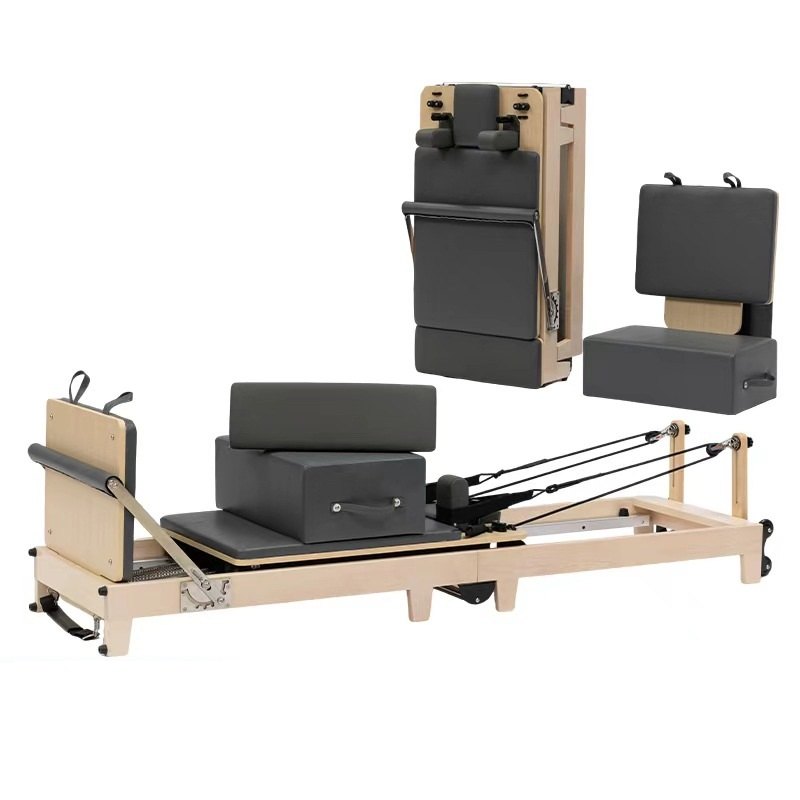
Floor space is usually the first constraint a new studio hits — and it is the reason foldable reformers exist. They promise the same workout in a machine you can stand against a wall when the room is needed for something else.
That promise is real, but it comes with trade-offs. Here is how to decide whether a foldable model belongs in your order.
What a foldable reformer actually is
A foldable reformer does the same job as a standard one — a carriage on rails worked against springs — but the frame folds or splits so the machine can be stored upright or moved on castors.
Foldable models come in different frame materials too. Ours are built in maple and in steel, so the choice is not only about folding, but about material as well.
The point is storage: when the class is over, the footprint shrinks dramatically.
Where foldable models win
Small or shared rooms. A yoga studio that wants to offer reformer sessions twice a week, a hotel gym with limited floor area, a physiotherapy room that doubles as a treatment space — in all of these, a machine that disappears after use is worth a lot.
Home and personal training use. For a client training at home, or a mobile instructor working across locations, a standard reformer simply may not fit through the door.
Multi-purpose spaces. Community centres, corporate wellness rooms and small gyms often need the floor back for other activities.
Tight doorways and awkward access. Foldable frames are easier to move into a room that a fully assembled machine would not get through.
What folding does not change
Folding changes how the machine is stored, not what it can do. Unfolded, a foldable reformer offers the same movement range, the same spring resistance — five to six springs per machine is the commercial standard — and a working length comparable to a fixed machine. In a session, your clients will not notice a difference.
What does change is how often the machine can realistically be used, day after day.
Where they give something up
Being honest about this matters, because the wrong choice costs more than the money.
- Stability. A folding frame has moving joints. Under heavy daily commercial use, those joints need checking and occasional adjustment — more than a fixed frame does.
- Load and duty cycle. Foldable models suit light to moderate use. A room running six classes a day is better served by a fixed commercial frame.
- Setup time. Folding and unfolding takes a minute or two each way. Negligible once a day; annoying six times a day.
- Wear on the folding mechanism. Ask what the hinge and locking hardware is rated for, and how it is maintained.
The decision in one line
If the machine will be used a few times a day and stored in between — foldable makes sense. If it will be used all day, every day — buy a standard commercial frame.
Most studios are better off with standard reformers for the group timetable, plus one or two foldable units for private sessions, home visits or overflow.
What to check before ordering
- Folded and unfolded dimensions — measure both, and check the folded height against your ceiling or storage alcove
- How the frame locks — a positive lock you can feel and see, not just friction
- Weight and castors — if one person needs to move it alone, check the weight
- Hinge and joint maintenance — what needs tightening, and how often
- Warranty on the folding mechanism specifically — not just the frame in general
- Whether it can be mixed with standard models in the same order (ours can — MOQ is 5 pieces)
Practical mixes that work
- Small studio, limited space: 4 standard reformers + 2 foldable for privates
- Hotel or corporate gym: 2 foldable reformers, stored when the room is needed
- Home or mobile instructor: 1 foldable reformer
- Growing studio: start with standards, add a foldable when private work picks up
A note on assembly and care
Selected models include an English printed manual, and installation videos are available for every model — worth requesting before delivery so you know exactly how the folding mechanism goes together.
Once it is in use, wipe the frame down with the rest of the equipment and check the folding joints as part of your monthly visual check. Folding hardware that is looked at regularly will outlast hardware that is ignored.
We build reformers, tower reformers and Cadillac reformers in aluminium, oak, maple and beech, plus foldable models in maple and steel, ladder barrels, chairs and studio equipment. Tell us your room dimensions and how often the machine will be used, and we will tell you honestly whether folding is the right call — including when it is not.
Choosing reformers for a studio or a first container?
Send us your room dimensions, expected weekly usage and destination port. We will tell you which frame and specification actually suits you — and if a cheaper option is the right one, we will say so.
Request a quote